Hair assessment: What a scalp exam and hair tests reveal
A hair assessment can help you understand what may be contributing to shedding or thinning by bringing together your hair-loss history, the pattern of thinning, your usual hair colour and texture, and the condition of your scalp. A clinician may also use a gentle hair-pull test to assess active shed…

A hair assessment can help you understand what may be contributing to shedding or thinning by bringing together your hair-loss history, the pattern of thinning, your usual hair colour and texture, and the condition of your scalp. A clinician may also use a gentle hair-pull test to assess active shedding and computerized trichometric analysis to document hair characteristics in a more structured way.
That broader view matters because hair can thin with age, and hair loss can also be related to health conditions or medication. Considering the scalp and strands alongside the timing and pattern of change helps distinguish visible signs from concerns that may need closer investigation.
You’ll learn what a scalp examination looks for, how colour and texture add context, and what a pull test can reveal. The article also explains how computerized analysis contributes to an evaluation, so you can better understand what these observations may tell you about your hair and scalp.
Key Takeaways
- Understand how your hair-loss history, shedding pattern, scalp findings, and any relevant tests can help build a clearer picture of possible causes.
- Learn which changes in scalp condition, hair density, colour, or texture may be useful to note during an examination.
- See what a gentle pull test and computerized trichometric analysis can reveal about shedding and hair characteristics.
- Use assessment findings to shape a more personalized hair-care routine and consider whether a consultation or serum fits your needs.
Table of Contents
What Is a Hair Analysis Test?
A hair analysis test combines history, scalp examination, and laboratory testing to evaluate hair loss.
Medical History and Hair-Loss Patterns
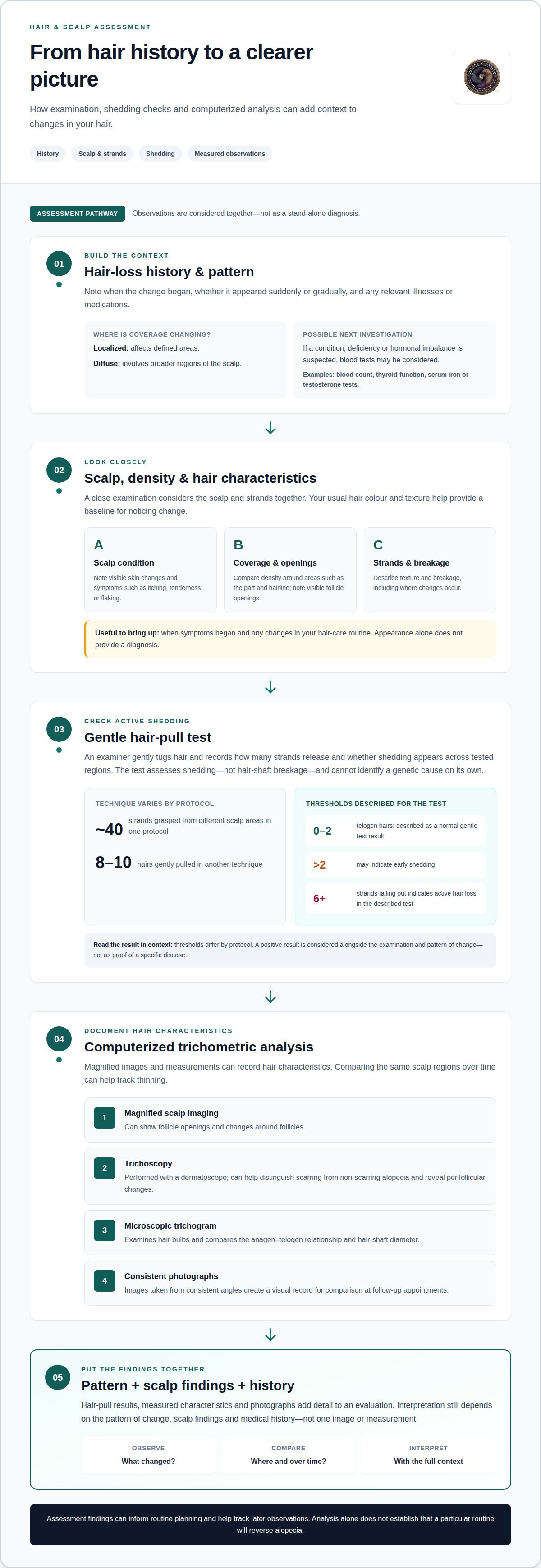
Medical history records when hair loss began and whether it started suddenly or gradually. It also covers relevant illnesses and medications. These details help evaluate possible causes. If a condition, deficiency, or hormonal imbalance is suspected, blood tests may be considered, such as a blood count, thyroid-function, serum iron, or testosterone tests. Results can inform treatment planning.
Localized and Diffuse Hair Loss
Localized hair loss affects defined areas, while diffuse loss involves broader regions of the scalp. During an examination, a clinician records which areas are affected and whether thinning follows a pattern. Alopecia refers to hair loss, including patches of baldness or total absence of scalp hair. Mapping changes helps distinguish focal concerns from widespread shedding and guides clinical evaluation and next steps.
Hair Distribution and Hair Loss
Hair distribution describes how coverage varies across the scalp and body. A clinician compares affected regions and notes whether the change is gradual or follows a pattern. Hair may thin with age, and some people develop bald areas, particularly with male-pattern baldness. This comparison provides context for examination findings before treatment recommendations or routine planning.
Hair and scalp colour, texture, and condition
A close examination considers scalp appearance and hair characteristics together. Your usual hair colour and texture provide a useful baseline for noticing changes over time.
Scalp Health, Density, and Pores
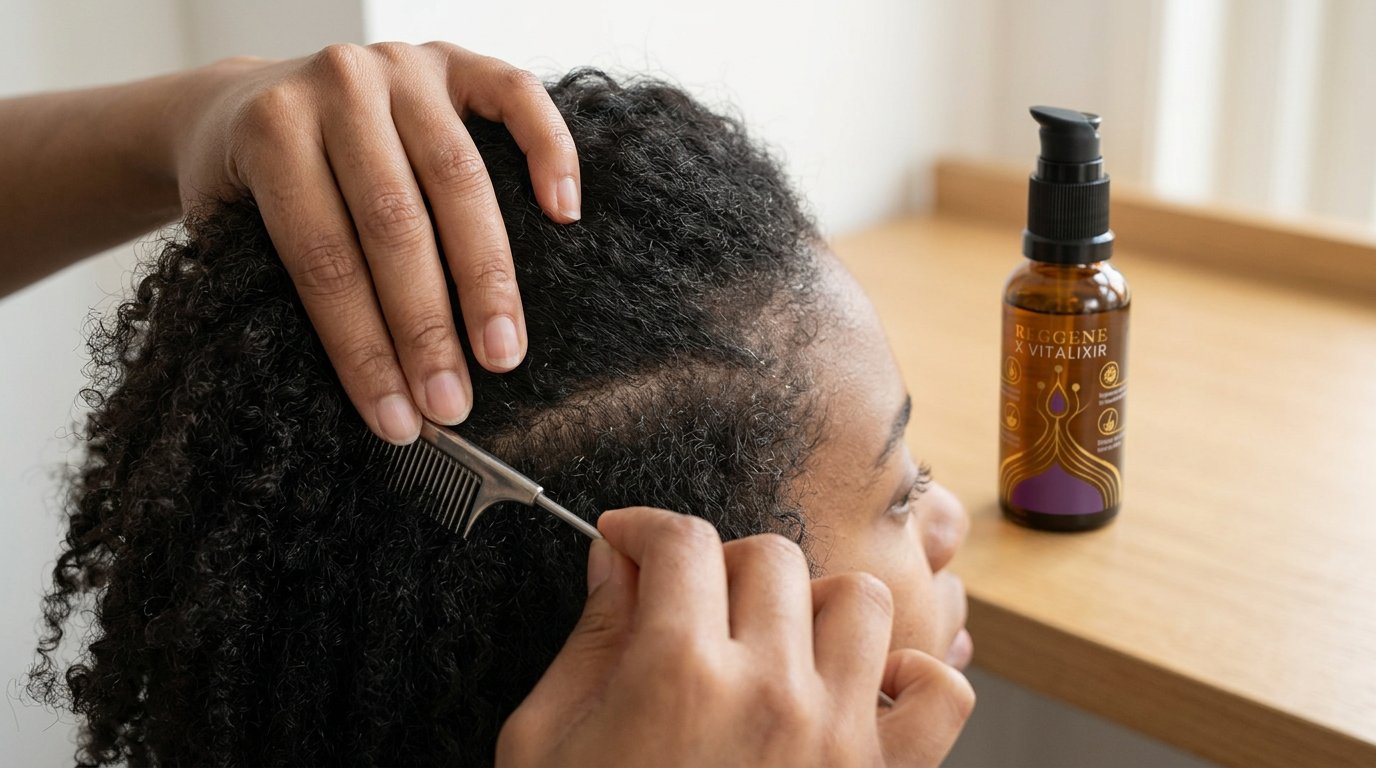
Scalp condition includes visible skin changes, while density describes how much hair covers an area. An examiner compares areas such as your part and hairline, noting changes in coverage and visible follicle openings. These observations help describe whether a concern appears concentrated or spread across the scalp, but appearance alone does not provide a diagnosis.
Physical Examination of Hair and Scalp
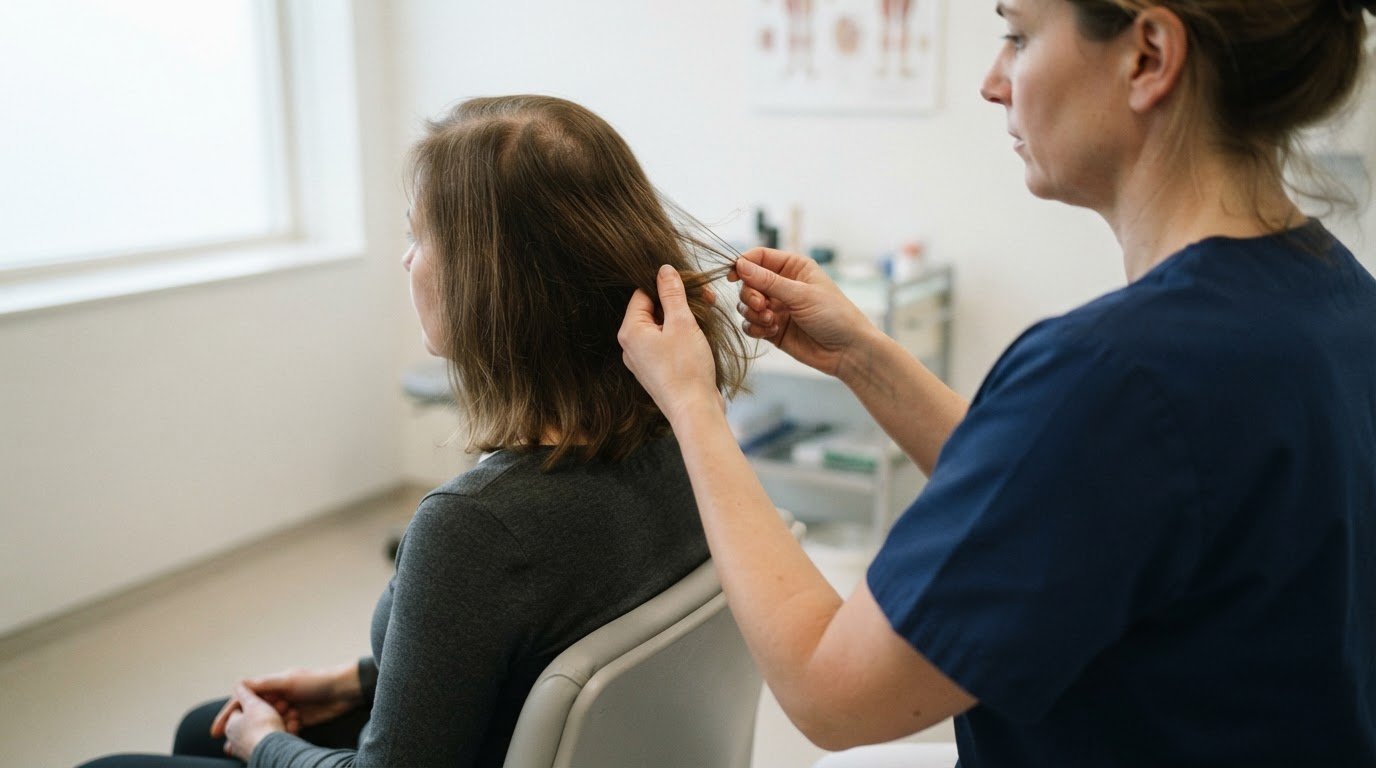
The examination can include looking along the hair strands and behind the ears for skin changes. Mention symptoms such as itching, tenderness, flaking, or breakage, and explain where they occur. A fungal culture can investigate suspected scalp ringworm; results may take several weeks. Before the appointment, note when symptoms began and any changes in your hair-care routine.
Professional and At-Home Assessments
A professional examination allows direct inspection of your scalp and hair; an at-home check depends on what you can see and feel. A mirror can help you observe your part, hairline, and visible scalp, but it cannot reveal skin findings as closely. Share these observations during an assessment rather than treating them as a diagnosis.
Assessing Hair Type and Texture at Home
Observe your hair after washing and drying it as usual. Note its natural shape, how the strands feel, and how quickly they absorb water. Compare coverage along the same parting. These observations can help describe hair type, texture, porosity, and density, but they do not establish a medical cause for a change.
Hair pull test
A hair-pull test checks active shedding by measuring how many hairs are released with a gentle tug. It assesses shedding, not hair-shaft breakage, and cannot identify a genetic cause on its own.
Techniques vary: one protocol grasps about 40 strands from different scalp areas; another gently pulls a section of eight to ten hairs. The examiner records how many hairs release and whether shedding appears across tested regions. Results from different areas help show whether active shedding is more widespread or concentrated.
A gentle test normally extracts 0-2 telogen hairs. More than two may indicate early shedding, while six or more strands falling out indicates active hair loss in the described test. These thresholds differ by protocol, so a positive result is interpreted alongside the examination and the pattern of change, not as proof of a specific disease.
A related daily hair-loss test uses collected shed hairs to examine the anagen-telogen ratio, the balance between growing and resting hairs. Unlike a single tug, this technique considers hairs shed over time. Together, these tests can add detail to a hair and scalp evaluation, while medical history and visible findings help put the results in context.
Computerized trichometric analysis
Computerized trichometric analysis uses magnified images and measurements to document hair characteristics. Comparing the same scalp regions over time can help track thinning. The findings add detail to an examination, but they do not identify every cause of hair loss on their own.
Magnified scalp imaging can show follicle openings and changes around follicles. Trichoscopy, performed with a dermatoscope, can help distinguish scarring from non-scarring alopecia and reveal perifollicular changes. A microscopic trichogram examines hair bulbs and compares the anagen-telogen relationship and hair-shaft diameter. Together, these observations describe different aspects of hair growth and scalp condition.
Digital photographs taken from consistent angles provide a visual record for comparison at follow-up appointments. Combined with measured hair characteristics, they may show changes in coverage or thinning. Interpretation still depends on the pattern, scalp findings, and medical history, not a single image or measurement.
These details can inform a hair-care routine by clarifying where thinning appears and which changes to monitor. For example, recorded findings can guide a discussion about targeted care and help track later observations. Analysis supports planning, but does not establish that a particular routine will reverse alopecia.
Planning a hair regrowth routine
Assessment findings help shape a routine around your scalp condition, hair pattern, and care needs. A localized thinning area may call for different monitoring than diffuse shedding, while dryness or irritation can affect which cleansing and conditioning steps feel suitable. The goal is a clear, manageable plan, not a collection of unrelated products.
A personalized evaluation can connect observed changes with practical recommendations. It may consider your current hair-care habits, the areas you want to address, and whether further medical evaluation is appropriate. Keep your routine consistent, note changes in shedding or scalp comfort, and review those observations when your plan is reassessed.
For tailored routine recommendations, the Regene X Vitalixir Hair & Scalp Consultation includes personalized evaluations. Findings can also help you consider whether the Regene X Hair Growth Kit or Regene X Vitalixir Hair & Beard Regrowth Serum fits your care plan. These products may be part of a routine, but they do not replace investigation of a suspected medical cause of hair loss.
Regene X Vitalixir Hair & Beard Regrowth Serum
ReggeneX Labs can help you connect assessment findings with a considered hair-care plan. The Regene X Vitalixir Hair & Beard Regrowth Serum is an option when a topical product fits your goals and routine. An assessment can guide that decision, but it does not establish that a serum is suitable for every cause of hair loss.
Personalized evaluations through the ReggeneX Vitalixir Hair & Scalp Consultation can help you think through your scalp and hair concerns, then shape routine recommendations around them. You can also consider the ReggeneX Vitalixir Shampoo and Regene X Vitalixir Conditioner as care options alongside a serum. Products undergo clinical testing, but that fact is not a promise of a particular outcome for your hair or beard.
Keep your plan focused. Consider what the evaluation observed, which areas you want to care for, and whether your routine is practical to maintain. If your assessment points to a possible medical cause, product choices should not replace appropriate medical evaluation. The serum is an option for personal care, not a diagnosis or guaranteed treatment.
For guidance on how these options fit your concerns, contact ReggeneX Labs.
Netherlands delivery and customer support
Customers across the Netherlands can order Regene X Vitalixir Hair & Beard Regrowth Serum for delivery. For an order enquiry, share the relevant details so the support team can understand whether you need help with delivery or a product. Delivery questions are separate from hair and scalp guidance, so describe the issue you need help with.
If you’re concerned about thinning, scalp condition, or routine choices, the Regene X Vitalixir Hair & Beard Regrowth Serum Hair & Scalp Consultation offers personalized evaluations and routine recommendations. Use it to discuss what you’ve noticed and consider care options such as Regene X Vitalixir Hair & Beard Regrowth Serum Shampoo or Regene X Vitalixir Hair & Beard Regrowth Serum Conditioner.
For trichology-related questions, ReggeneX Labs offers hair and scalp guidance tailored to your concerns. Beard-care discussions can focus on your goals and whether Regene X Vitalixir Hair & Beard Regrowth Serum, marketed for hair and beard regrowth, fits your routine. Product guidance does not replace medical evaluation for a suspected health condition.
Pharmacies interested in distribution partnerships can contact ReggeneX Labs to discuss their enquiry. For help with an order, a personalized consultation, or product guidance, explain your needs clearly so the conversation can focus on the right topic.
Choose a clear next step for your hair concerns
Before acting on a hair assessment, decide what you need to clarify: whether a change calls for further investigation, or how to make daily care more considered. These are different goals. A focused conversation can help separate questions about clinical testing from questions about a personal-care routine, without treating a product choice as a diagnosis.
Bring the concern that matters most to you and explain what you hope to understand. The ReggeneX Labs team can help you frame questions about testing and discuss how its hair-care guidance fits your goals. If you’re concerned about a medical cause, keep that distinct from product and routine discussions.
Your next step can be measured and personal. Contact ReggeneX Labs to discuss testing and the questions you want answered. A clear conversation can help you move forward with greater confidence and care.
Frequently Asked Questions
What is a hair assessment and what does it evaluate?
A hair assessment helps organize your concerns and identify which questions need attention. It gives structure to a discussion about changes you’ve noticed instead of relying on one isolated sign. Before an appointment, decide which change matters most and what you hope to understand. This keeps the conversation focused on your needs and possible next steps.
What happens during a professional hair and scalp assessment?
You should be told what the examination involves and why each part may be useful. Share your preferences about touching or handling your hair, and ask for an explanation before an unfamiliar procedure. If you have cultural or personal reasons for avoiding hair contact, say so. Clear communication helps shape an assessment around your comfort and boundaries.
Can I get a hair assessment in the Netherlands?
If you’re in the Netherlands and want to discuss a hair or scalp concern, a personalized consultation can help you talk through your goals and routine questions. The right next step depends on whether you’re looking for personal-care guidance or medical investigation.
Where can I get a hair assessment: dermatologist, trichologist, or salon?
For readers in the Netherlands seeking hair-care guidance, the ReggeneX Vitalixir Hair & Scalp Consultation offers personalized evaluations and routine recommendations. Use it to discuss your personal-care goals and the questions you want addressed. If you’re concerned about a suspected disease or medication-related change, make that distinction clear, since product and routine guidance is not a medical diagnosis.
What tests may be used to assess hair loss or scalp conditions?
Testing depends on the question being investigated. A hair-mount test examines hair under a microscope for shaft abnormalities and can help identify congenital hair disorders or infections. Other investigations may focus on blood markers or scalp tissue. Each test contributes a different kind of evidence, so results are interpreted alongside your symptoms and examination findings.
What are the risks or limitations of online hair assessments?
An online assessment can help you describe concerns, but photos may misrepresent colour, density, or scalp visibility when lighting and camera angles vary. A questionnaire also depends on how accurately you describe changes and relevant context. It cannot physically examine your scalp or collect a sample. Treat an online result as an initial guide, not a definitive explanation for a change.